
All news and blog posts

Centre for Protecting Women Online Concludes Inaugural Annual Conference at The Open University
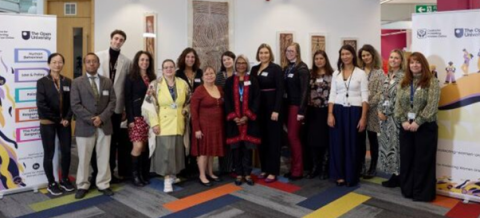
The Centre for Protecting Women Online (CPWO) held its first annual conference which brought together global experts, academics, practitioners, advocates, and partners to share insights and strategies for tackling online violence against women and girls (OVAWG).

Faculty part of successful £4.9M bid to lead research skills hub for social scientists
The OU Faculty of Business and Law, PolicyWISE, and the Institute of Educational Technology have secured £4.9M from the ESRC to lead a new Research Capability Hub. Over five years, the Hub will support social scientists across sectors and career stages, using OU’s innovative tech to deliver inclusive, future-focused research skills training.

More graduates are tipping the scales of justice
Two of our Bachelor of Laws (LLB) alumni who live near England’s South Coast, both now undertaking AI-related postgraduate studies, show that the OU caters for both school leavers and those wanting a career change a bit later in life.

Law grad Krishangi makes history once again
Our youngest ever OU Law graduate Krishangi Meshram is in the record books again – qualifying as the youngest solicitor in England and Wales in recent times.

Free online resources to promote a safer use of AI in legal settings
The Open Justice Centre has launched a new suite of free resources to help the legal sector navigate the opportunities and challenges of Generative AI. With AI tools rapidly evolving, legal professionals and self-representing individuals face risks from misinformation, yet lack access to trusted, free guidance.

Business and Law students win cash for their enterprises
Three students from the Faculty of Business and Law (FBL) have received a share of the £30,000 prize pot awarded through the Open University’s Open Business Creators Fund.

"The OU gave me the second chance I’d been looking for,” says gym owner turned solicitor
Approaching 40, Helen from Stoke-on-Trent decided to pursue her long-held dream of a legal career. Despite holding an arts degree and co-running a successful gym, she studied law with the Open University and is now training as a solicitor.

OU cheers its youngest ever law graduate at UK ceremony
The Open University (OU) is proud to congratulate Indian alumnus Krishangi Meshram on becoming the university’s youngest ever Law graduate.
The Open University Establishes New Centre for Protecting Women Online Following £7.7 Million Grant from Research England
The Open University (OU) has launched a pioneering Centre for Protecting Women Online, made possible by a substantial £7.7 million grant from Research England. This new initiative aims to address and mitigate the online harms faced by women and girls, focusing on research to inform legislative, policy, and technological solutions.

New report recommends better assessment design to tackle potential AI threat to academic integrity
A pioneering new report looking at the impact of generative artificial intelligence (gen AI) on different types of assessment has recommended that performance of tools, such as ChatGPT, should be used to inform and upskill assessment design, rather than trying to detect misuse.
Get in touch


Explore

Undergraduate
Postgraduate
Policy
-
Follow us on Social media
-


