
Traffic accident in space creates work for lawyers
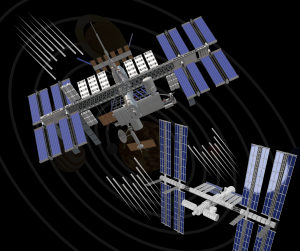
An almighty high-speed collision in space highlights the challenges of determining extra-terrestrial fault. Two satellites, Iridium 33 & Cosmos 2251, in low earth orbit hurtled into each other at over 20 thousand miles per hour, scattering lethal debris throughout earth's orbit . Despite the negative consequences for the satellite owners and all other users, liability remains undetermined and, for the time being, undeterminable. This regulatory gap poses problems for all users in low earth orbit.
One underlying issue is the very different context of some parts of space compared to the terrestrial jurisdictions that we are used to and might draw analogies from. On earth, friction and gravity rapidly bring moving bodies either to a halt or crashing to earth. It takes almost constant injections of energy to keep a terrestrial body such as a car or aeroplane moving, meaning that the causal consequences happen within seconds or minutes, and are thus relatively foreseeable.
By contrast, the limited friction in space extends the causal consequences for years. In low earth orbit, satellites must necessarily be moving to prevent them falling to earth. In orbit, satellites may happily pass each other multiple times before their trajectories are due to coincide. Predicting potential collisions and manoeuvring to avoid collisions therefore requires sophisticated mathematical modelling that may be onerous to undertake, particularly where there are multiple satellites to account for.
Relatedly, the applicable norms for satellite behaviour are not well established in the way norms have been established for terrestrial vehicles. For example, the Geneva Convention on Road Traffic 1949 was developed under the auspices of the UN; maritime vessels are governed by the International Maritime Organisation's International Regulations for the Prevention of Collision at Sea; and rules for aircraft are contained in Annex 2 of the Convention on International Civil Aviation.
It is also not always straightforward to extend terrestrial norms to space, given the very different physical environment discussed. On earth an unexpected departure from established norms often grounds a finding of fault. Examples include the expectation that the driver of a motor vehicle following to the rear is the one primarily responsible for not colliding with the vehicle in front, and when two aeroplanes approach each other on a collision course, both are expected to turn right. Without these well established and near-universally followed norms, chaos would inevitably ensure.
Some of these domestic norms are simple extrapolations of common sense that we might call 'overt' norms because most people would unilaterally accept them. For example, it makes sense for the driver behind to be the one to watch out because they are by definition looking forward and the driver in front does not have eyes in the back of their head. Other norms with might call 'oblique' have to be settled upon by advance agreement. For instance, vehicles or aeroplanes could pass each other on either the left or the right; agreement to one solution or the other is arbitrary, but consensus is essential.
In space, due to the different context discussed above, there seem to be precious few overt norms, meaning that oblique norms need to be arrived at through discussion and agreement. So far, little progress has been made along these lines. Article VII of the Outer Space Treaty 1967 makes states liable for damage caused by objects launched into space, but this does not mean 'strictly liable' in the sense of liable for any damage that would not have happened 'but for' the launching of the object. Article II of the Space Liability Convention of 1972 does provide for strict liability, but only for damage on the ground or to aircraft in flight. Article III relates to damage caused elsewhere and is fault based. A particularly relevant provision of the Liability Convention is Article XII which specifies that liability for damage 'shall be determined in accordance with international law and the principles of justice and equity', seemingly assuming the existence of sufficient overt norms.
The consequence is that there seems to be a huge lacunae in the law. Responsibility for the Iridium 33 & Cosmos 2251 has never been assigned. Increasing numbers of satellites are being launched, meaning the need for active engagement to settle on a number of overt norms is increasingly pressing. Space law, which sometimes seems somewhat theoretical, has never been more relevant.

Paul Troop
Paul is a lecturer for the Open University Law School. He set up and runs W360's International Law Project, where students work with international non-governmental organisations to assist with legal research.
Paul has produced, or is producing, materials for courses W102, W112, W250, and W360 on topics including legal theory, legal decision making, law and economics, and expert evidence.
Get in touch


Explore

Undergraduate
Postgraduate
Policy
-
Follow us on Social media
-


