
A seat at the table: a law student at Downing Street
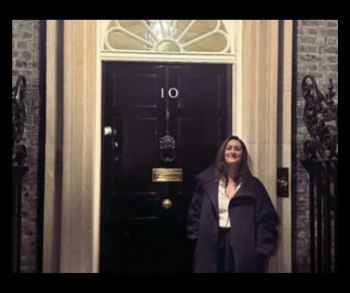
In January 2026, I found myself standing inside 10 Downing Street, attending a reception to mark the enactment of the Employment Rights Bill. For many, this might sound like a moment of professional prestige or political curiosity. For me, it was something much more profound: a reminder that lived experience, when taken seriously, can shape the law in ways that materially change people’s lives.
I am a final year law student, at The Open University (OU), a parent carer to three children (one of whom is disabled), and an intern with the Law School’s Belonging Project. My route into legal education has not been linear. Like many OU students, I study remotely, around caring responsibilities, navigating employment and education systems not designed with people like me in mind. That perspective is precisely what brought me into policy work around flexible working.
Last year I was asked to be a member of the Timewise Workers Advisory Group, contributing evidence and insight to senior government policy advisors during the development of the Employment Rights Bill. Timewise is a not-for-profit organisation dedicated to improving access to fair, flexible and high-quality work. My contribution focused on flexible working rights, particularly for unpaid carers, who are disproportionately pushed out of employment not because of lack of skill or commitment, but because of structural inflexibility.
When discussions around flexible working are abstract, they are often framed as a ‘nice to have’ or a perk. When you view them through the lens of caring, disability, and gender inequality, they become a matter of access to any employment at all. Carers UK (2025) report that 600 unpaid carers leave their jobs every single day, and WPI Economics (via Carers UK, 2025) research found that being out of work is the single strongest quantitative predictor of poverty for unpaid carers. So, for parent carers of disabled children, flexibility is not about convenience, it is about survival.
During the evidence-gathering process for the Bill, I shared my experiences of attempting to combine paid work, caring, and study. Like many carers, I have faced the frustration of being seen as ‘too qualified’ for low-paid flexible roles, and ’too inflexible’ for roles that match my skills. My voice was not a lone one, other members had similar experiences. What these shared experiences show is that the failing is not individual, but systemic.
The Employment Rights Act is one of the most substantial reforms to UK employment law in over a decade. It is expected to affect more than 15 million working people across England, Scotland and Wales. For employers, it signals a future shift in how flexible working, dismissal risk and sickness absence are approached, although many measures will require secondary legislation before they come fully into force. This work is at the coalface of culture, putting the ‘human’ back into human resources.
For carers, the significance of the Act is immediate and deeply personal. Strengthening the right to request flexible working from day one of employment changes the balance of power. Other legislative progress such as the Carer’s Leave Act (2023), which enshrined in law the right for carers to take up to five unpaid days of carers leave a year also acknowledges carers’ needs in the workplace. I hope this is a provision that will be built upon over time. The Employment Rights Act reframes flexibility not as an exception granted at an employer’s discretion, but as a legitimate, anticipated feature of modern working life. In my view, this change alone will be the difference between employment and unemployment for many parent carers like me.
Being invited to Downing Street to mark the Act’s passage was therefore not just symbolic. It was affirming. It demonstrated that contributions made by people outside traditional policy and legal elites, like students, carers and people with lived experience can and do matter. Standing in those rooms, I was acutely aware that I was there not despite being a carer, but because of it. The reception itself was quite an intimate affair, with a speech from the Prime Minister, Sir Keir Starmer, and was attended by Angela Raynor MP (the Bill’s main advocate), Marie Tidball MP and senior No.10 staffers. I was able to chat with Ange (as the PM calls Angela Raynor!) and express just how revelatory this Act will be for people like me.
This experience has also reinforced why belonging in legal education matters. As an intern with the Law School’s Belonging Project, I have spent time researching the factors that affect student experiences, particularly for students who are marginalised by caring responsibilities, disability, or socio-economic disadvantage. A recurring theme is visibility: students persist when they can see themselves reflected in the institution, its curriculum, and its understanding of success. The phenomenal work by the OU Open Futures Fund is evidence of this, and I am fortunate to be a recipient of an OU Carers Scholarship. The investment the OU is putting into carers now has a much greater chance of translating into the working world with this Act in place.
Legal education often presents the law as something that happens ‘out there’, shaped by courts, Parliament, and professionals with uninterrupted careers. My journey has shown me that the law is also shaped by everyday lives, by the practical realities of caring, working, and trying to belong. When those realities are excluded, the law becomes thinner, less just, and less effective.
As I approach graduation, I am conscious that my future career may not follow a conventional path. But attending the Downing Street reception reminded me that impact does not depend on fitting a mould. It depends on persistence, tenacity, and the willingness of institutions to take inclusion seriously.
If there is one lesson I would pass on to fellow law students, particularly those juggling responsibilities that are often invisible, it is this: your experiences are not a distraction from the law. They are a lens through which the law can be improved.
And sometimes, if you are lucky, that lens takes you all the way to Downing Street.
References
- Carers UK, Facts About Carers, 2025.
- WPI Economics Family Resources Survey, 2021/22, cited in Carers UK, Poverty Amongst Unpaid Carers in the UK, 2024.
Rebekah Zammett
Rebekah is a final year LLB student with the OU. Rebekah was awarded an Open Futures Fund Carers Scholarship to fund her degree. Rebekah lives in Oxfordshire and is parent to three children, including her disabled teenage son. She is due to graduate this year and looking to pursue a career in public policy and leadership. Rebekah has contributed to various research around caring, working practices, and was awarded the Middle Temple Access to the Bar Award. Rebekah is the current Law School Belonging Project Intern.
Get in touch


Explore

Undergraduate
Postgraduate
Policy
-
Follow us on Social media
-


