
Outside my comfort zone: Lessons from the ALT Conference and the future of legal education

A scary invitation
I approached the invitation to sit on the panel entitled ‘Meaningful Staff–Student Partnerships in the Law School’ at the Association of Law Teachers (ALT) annual conference with mixed feelings. The panel offered a valuable opportunity to discuss my work on student and staff partnerships, to attend the ALT Conference, and to visit Exeter University; a place I had never been. I knew the conference would be an excellent chance to update my knowledge, yet I still felt a sense of trepidation. I had never sat on a panel before!
Would I remember my work clearly?
Would I be able to answer questions sensibly and logically?
These doubts circled in my mind until I recalled something my first manager at The Open University (OU) told me when I joined: ‘You will have many opportunities; some will push you outside your comfort zone. Be prepared to be made uncomfortable.’
With that in mind, I accepted the invitation. Before long, I found myself travelling to Exeter University for the ALT conference, ‘Reimagining Legal Education for the Future.’
A little relaxation before the conference

I live in Yorkshire, so I travelled down the day before the event. This meant I could attend the welcome drinks, which gave me the chance to catch up with an OU colleague and spend time with others from beyond the OU discussing the scholarship of teaching and learning.
I also took the opportunity to enjoy a well‑deserved walk around parts of Exeter - much needed after the long drive. The city has some fascinating buildings, and the hills certainly gave my calves a good workout!
Will there be a need for lawyers in the future?
My panel was first on after the welcome session. At this point I was feeling quite stressed and was grateful for the supportive comments from other panel members. From my perspective being on first meant I could relax and engage with the rest of the conference presentations.
The lunchtime keynote was delivered by Sir Geoffrey Vos (Master of the Rolls and Head of Civil Justice (England and Wales)) with a session entitled ‘Lawyers and Legal Education in the Machine Age’. Sir Geoffery argued that it is wrong to suggest that lawyers will not be necessary in the future, however their role will be different. He argued that basic economics will dictate that routine justice will be carried out by AI, for example working out compensation or completing forms. However, the law could not be developed in the way that judges do in the court room, (for example via statutory interpretation) by a machine, therefore judges and lawyers would always be needed. In the machine world the first port of call is the internet to solve legal problems and, as a result, the courts are seeing an increase in litigants in person (of course this may also be a response to the cost of legal representation).
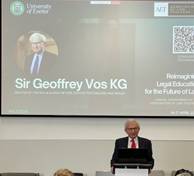
People will only reach out to lawyers when they need reassurance and confirmation about the law or its complexities. This kind of approach will result in a reduction in recruitment and lawyers of the machine age will need the social skills that will enhance the development of a relationship of trust. In Sir Geoffery’s vision lawyers would work from home more and justice will need to be delivered at speed. To conclude he argued that law teaching must change to meet this new world, with a focus on understanding the outputs from AI rather than the ability to conduct lengthy legal research. Professional ethics would need to be viewed in a different lens with the ability to spot AI fakes combined with an in-depth understanding of data protection and security. This certainly left me thinking about the impact of AI on the legal profession and wondering how the profession and legal education will change in the next 20 years.
Partnership and Belonging – my safe place
After lunch I focused on the Partnership and Belonging stream which contained sessions which were directly relevant to my OU scholarship of teaching and learning. Lucy Yateman of Liverpool University shared her work on ‘What do students want from assessments’. This project had involved students working as partners and explored their experiences of assessments. Students identified, not unsurprisingly, that assessment is stressful, but this stress can be reduced with clear guidance and proper preparation for the assessment, something which has been mirrored in my own work – always good to have something reaffirmed! Many of the students engaged in Lucy’s work were involved in a Law Clinic and they valued the opportunity to undertake real world tasks, appreciating the variety this can offer. However, they caveated this with not wanting too much variety. Equally they appreciated the opportunity to work as a group but felt clearer direction is sometimes necessary.
Lucy presented another session with a colleague, Louise Hewitt entitled ‘Peer learning- From Law Clinics to Large Group Teaching’ in which they shared their experiences of peer learning. As the name suggests peer learning, often referred to as collaborative learning, involves the students working together in small groups to maximise their learning and solve problems (Hanson et al 2016). Given that this pedagogy underpins much of the teaching on the OU Open Justice module (W360), where I am the Student Experience Manager, I was particularly interested in exploring what ideas I could glean from this session. Initially the benefits of peer learning were explored, including its importance in developing a key employability skill – the ability to work with others. However, it was argued that the golden thread to successful peer learning was trust and good communication between both students and the staff they work with. It was suggested that by slowing the learning process down and allowing students to get to know each other and the staff they are working with, trust could be developed. This is something I will be reflecting on and taking back to my module.
GenAI - again
The following days focus for me was GenAI. Kirsten Maslen of Thomason Reuters discussed how legal thinking can be preserved in the age of AI. She argued that using AI was becoming increasingly common within the legal profession for such things as legal research, document review and drafting. With this in mind she argued that students needed to develop competences in question formation, source judgement, critique and accountability. Students will need to use AI but must be able to account for its use and be able to explain why they selected a particular answer. Just like Sir Geoffery Vos the previous day, Kirsten was presenting a world in which legal professionals will use AI therefore requiring Universities to train their students in its ethical uses. This leaves the sector with a key question, should we be training our students to use AI and how do we do this?
Reflection
My two days at the ALT conference seemed to fly by and I have come home with so many ideas which I look forward to discussing with the potential implementation on the modules I work on. But, for me, the conference raised wider questions on the use of AI and how we prepare students for the legal world of the future.
In conclusion I am so glad I decided to push myself outside my comfort zone and be a panel member, it was a great experience and listening to my colleagues work on staff-student partnerships was highly motivational. It is good to push yourself sometimes!

Carol Edwards
Carol is a Senior Lecturer in Legal Online Pedagogy and Student Experience Manager, whose teaching is focused on providing authentic experiential learning experiences. She is actively involved in the scholarship relating to online teaching pedagogy and has presented and published on this area.
She has a very keen interest in tackling student and staff isolation and is actively involved in several projects attempting to address this area. These include the online mentoring programme, and The Belonging Project, with particular focus on developing student confidence and providing opportunities to develop communities of support. She is part of a pan-university team exploring belonging across the Open University. She is a Senior Fellow of the HEA.
References
Hanson, J. M. et al. (2016) ‘Evaluating the influence of peer learning on psychological well-being’, Teaching in Higher Education, 21(2), pp. 191–206. doi: 10.1080/13562517.2015.1136274.
Photographic images ©CJE 2026
Get in touch


Explore

Undergraduate
Postgraduate
Policy
-
Follow us on Social media
-


