
Courtroom 600, Nuremberg: eighty years on
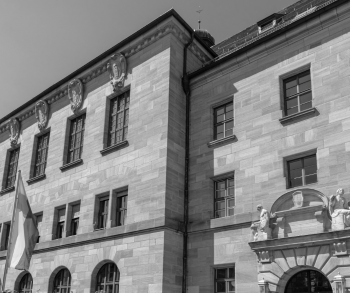
On the morning of 1 October 1946, in Courtroom 600, silence awaited the pronouncement of the verdicts on the defendants. Twenty-one besuited men, formerly senior leaders of the Nazi party, guarded by American GIs, crowded on two benches on one side of court. The world had heard all about the atrocities that they had committed during World War 2 over the preceding eleven months through the passage of eyewitness testimony, film footage, and affidavits from the start of the trial on 20 November 1945.
It is now eighty years since the end of that Nuremberg trial which resulted in the convictions of nineteen of the notorious German high command who had stood trial. Three were found not guilty with Martin Bormann found guilty in absentia. That concluded the retribution in effect that was exacted by the combined International Military Tribunal (IMT) set up by the Allies which resulted in the death sentences being subsequently carried out on the twelve guilty men, though Göring escaped that having committed suicide the night before the sentences were carried out.
Certainly, with the Russell Crowe film ‘Nuremberg’ released last year, and its display of poignant images including footage from concentration camps, and the book ‘Nuremberg Women’ by Natalie Livingstone, there is now greater awareness of the trial and its significance.
However, on this anniversary, consideration can be given as to how the Nuremberg trial is or conversely should be acknowledged. There are different but equally valid verdicts.
The 1945 trial was opened by Robert Jackson, the lead prosecutor for the United States where his words often repeated since provide the context and reminder as to what the Allies considered that the purpose of the trial was:
‘..The wrongs which we seek to condemn and punish have been so calculated, so malignant, and so devastating, that civilization cannot tolerate their being ignored, because it cannot survive their being repeated. That four great nations, flushed with victory and stung with injury stay the hand of vengeance and voluntarily submit their captive enemies to the judgment of the law is one of the most significant tributes that Power has ever paid to Reason.’
The following outlines some of the principles as to why the Nuremberg trial should be remembered.
Formation of the IMT
During World War 2, with the destruction of the rule of law through atrocities committed by the Nazis and their unimaginable scale, consideration was needed as to what actions the Allies should take in holding those responsible to account. Despite certain opposing views, revenge by means of summary justice was not to be undertaken.
The decision was made to hold a trial with the creation of the IMT. The over-riding feeling was that there was a need to avoid the mistakes made at the end of World War 1 where the Leipzig War trials had been held in 1921. There, German war criminals had been tried before the German Supreme Court (Reichsgericht). Though Articles 228 and 229 of the Treaty of Versailles had envisaged the hand-over of Germans to the allied authority, for justice to be applied, in practice, trying them was left to the German courts. The conclusion was that these trials had been unsuccessful as too few were tried and those that were tended to be minor players, the verdicts that resulted were too lenient, and the Germans themselves resented the proceedings. However, the actual concept of holding war trials post conflict did pave the way to considering that there must be accountability for war-time actions under international law. The Nuremberg trial plays an important role in the evolution of how war crimes were to be pursued. In time, the Nuremberg trial provided a precedent ultimately for the creation of the International Criminal Court in The Hague in 2002.
IMT’s role
It was argued however that establishing the IMT only represented victors’ (namely the Allies) justice. This argument can be made in part due to the absence of any equivalent proceedings being brought against the Allies for their alleged war crimes. Consideration of such war crimes might include the British Bomber command for actions such as the saturation bombing of Dresden in 1945 or the Russians in respect of the Katyn massacre. Potentially too, this could be applied to the judges who were appointed to sit and were accused of being allegedly biased. The judges came from the United States, United Kingdom, the Soviet Union, and France, the successful Allies.
The IMT was keen to demonstrate transparency in its proceedings in respect of the administration of justice. What can be seen therefore from film footage of the trials are the conventional trappings of the trial process that are adopted today. All defendants were provided with their own counsel, evidence was shared and presented, and the defendants were provided with the opportunity to provide their own account/defence. It can be deliberately seen in sharp contrast to justice administered by the German People’s Court. It too is captured in film footage which is most often associated with the prosecution of the perpetrators of the Hitler assassination coup. The judge, Roland Freisler demonstrably abandoned all semblance of judicial independence, due process or right to counsel by shouting and humiliating the defendants. Indeed, with the finding of not guilty verdicts that provides vindication as to the transparency and justice upheld by the Nuremberg trial.
Touching on a tangential dimension, Göring was successfully cross examined to establish that he had been fully aware of the commission of Nazi atrocities, with his defence being destroyed by the second UK Counsel, David Maxwell Fyfe who went onto become a Scottish judge.
Evidence
Presenting evidence at the Nuremberg trial was essential to establish individual accountability of the senior Nazi officials and to provide a historical record of the Nazi atrocities. Proof was needed to show that the defendants were indeed accountable and deny them the defence of obeying superior orders or in upholding their ignorance of the atrocities.
To achieve this, Nazi administrative records were used which had survived despite valiant efforts made at the end of the war to destroy them. These included a set of highly confidential minutes from the Wannsee conference held in 1942 which decided the implementation of the Final Solution. The trial included camp footage with testimony from those who survived including, as ‘Nuremberg Women’ recounts from Marie-Claude Vaillant -Couturier, a French Auschwitz survivor. The United States and British prosecutors had tended to rely on written testimony to avoid the necessity of asking witnesses to relive their experience. The French having suffered directly from occupation during the war wanted to have the court hear first-hand about what the trial meant to those who had lived and suffered in France.
New Crimes
There may be a view that the over-riding importance of Nuremberg trial lies in the creation of what were then designated as new crimes. These included crimes against peace, war crimes, and crimes against humanity. All were created through Article 6 of the Agreement for the Prosecution and Punishment of the Major War Criminals of the European Axis in London, England, on 8 August 1945 (‘London Agreement’ and ‘London Charter’ ) Leaders, organisers, instigators and accomplices participating in the formulation or execution of a common plan or conspiracy to commit any of these crimes were able to be held as responsible for all acts performed by any persons in execution of such plan. This was crucial in the verdicts that were returned against the defendants.
The legal origins of these crimes were conceived by two Jewish lawyers from Lviv, Hersch Lauterpacht and Rafael Lemkin. Lauterpacht conceived the legal concept of ‘crimes against humanity,’ while Lemkin developed the concept of ‘genocide’ defined as the destruction of a human group. These two crimes unusually were retrospective in their effect as they applied to actions that had taken place from 1939-45.
Unsuccessful arguments were made against the creation of new crimes. The defendants claimed that their creation denied State (German) sovereignty as they attempted to justify their actions based on what had been done was legal in accordance with what was then the existing German law. Unsuccessful arguments were made too that the creation of these crimes lacked impartiality, as the victors indeed had invented these new crimes to prosecute the defeated nation.
Translation
The trial introduced simultaneous translation to the court system. As the participants in court came from different countries with a number of languages, simultaneous translation ensured fairness for all. Had traditional consecutive interpretation be required, this would have massively increased the time required in court due to the length of the trials.
The IMT used innovative technology to permit simultaneous translation which was developed by IBM where one channel broadcast the original voice, while the other four channels provided interpretations into English, French, Russian, and German. Photographs show all wearing headphones which allowed them to listen to their language of choice. A core team of thirty-six interpreters rotated in shifts to address the psychological and mental challenges of that work. That is recognised today in the use of the term ‘vicarious trauma’, caused by the impact of the continuous strain of hearing about the nature of these atrocities. Its success led to the adoption of that practice by the United Nations and now within the European Union in proceedings. The UK courts tend not to use this method, relying still on consecutive translation.
Follow-up trials to the Nuremberg trial were held subsequently which included those specifically convened against specific groups such as doctors (December 1946- August 1947) and lawyers (17 February 1947- 14 December 1947).
At the end of the live proceedings completed by the final defendants’ statements on 31 August 1946, Willy Brandt, resistor, and future German president stated that ‘it would have been challenging to everyone’s sense of justice if the Nazi leaders had not been taken to account.’
The Nuremberg trial therefore stands as a significant legal milestone and commands justifiable attention, eighty years on.
Gillian Mawdsley
Gillian is a practising Scottish solicitor who teaches a number of modules at the OU as well as Edinburgh University. She has longstanding interests in the intersection of history and law and is a Commonwealth War Grave volunteer. She is writing a paper for a conference on September on enemy prisoners of war in World War 2 and their treatment.
Get in touch


Explore

Undergraduate
Postgraduate
Policy
-
Follow us on Social media
-


